

Table of contents
- 1. Understanding Introvert Energy: The Science Behind Social Batteries
- 2. The Hidden Costs of Energy Mismanagement for Introverts
- 3. Workplace Challenges: Navigating an Extroverted Professional Culture
- 4. The Energy Audit: Identifying Your Drains and Gains
- 5. Strategic Networking for Introverts: Quality Over Quantity
- 6. Digital Networking: Leveraging Technology for Authentic Connections
- 7. Remote Work Revolution: How Introverts Can Thrive in Distributed Teams
- 8. Building Professional Relationships Without Burning Out
- 9. Leadership Strategies for Introverted Professionals
- 10. Creating Sustainable Career Growth While Honoring Your Nature
- 11. Practical Tools and Techniques for Daily Energy Management
- 12. The Future of Work: Why Introverts Are Positioned for Success
- Conclusion
- References
In a world that often seems designed for extroverts, introverts face unique challenges in managing their energy and building professional networks. Despite comprising 56.8% of the global population according to The Myers-Briggs Company [1], introverts make up only 39% of top executives and earn on average $10,000 less than their extroverted counterparts [2]. This disparity isn’t due to lack of capability—research shows that introverted leaders actually drive 28% higher productivity from proactive, engaged teams [3]. The gap exists because traditional workplace cultures and networking approaches often fail to recognize and leverage the unique strengths that introverts bring to professional environments.
This comprehensive guide explores the science behind introvert energy management, provides practical strategies for professional networking that align with introverted preferences, and offers actionable insights for thriving in your career without compromising your authentic self. Whether you’re struggling with energy depletion from constant social interactions, finding networking events overwhelming, or seeking to advance your career while honoring your introverted nature, this article provides evidence-based solutions and real-world strategies.
The modern workplace is evolving, with remote and hybrid work models creating new opportunities for introverts to excel. Digital networking platforms are revolutionizing how professional relationships are built, offering asynchronous communication channels that play to introverts’ strengths. Understanding how to navigate these changes while managing your energy effectively can be the key to unlocking your full professional potential.
1. Understanding Introvert Energy: The Science Behind Social Batteries

The concept of introvert energy management goes far beyond simple shyness or social anxiety. At its core, introversion is a neurobiological preference for how we process stimulation and recharge our mental resources. Understanding this fundamental difference is crucial for developing effective strategies that work with, rather than against, your natural wiring.
The Neurological Foundation
Recent neuroscience research has revealed fascinating differences in how introverted and extroverted brains function. Introverts show higher baseline arousal in their nervous systems, meaning they’re naturally more sensitive to stimulation [4]. This heightened sensitivity isn’t a weakness—it’s actually linked to deeper processing, enhanced creativity, and superior pattern recognition abilities. However, it also means that environments with high levels of social, auditory, or visual stimulation can quickly become overwhelming.
The prefrontal cortex, responsible for planning, decision-making, and internal processing, shows increased activity in introverts. This explains why introverts often prefer to think before speaking, process information internally before sharing, and need quiet time to organize their thoughts. In contrast, extroverts show more activity in the anterior cingulate cortex and temporal lobes, areas associated with processing external stimuli and social interaction.
The Social Battery Concept
The metaphor of a “social battery” has become popular for good reason—it accurately describes how introverts experience energy depletion and restoration. Unlike extroverts who gain energy from social interaction, introverts have a finite amount of social energy that depletes through interpersonal engagement, particularly in stimulating environments.
This depletion isn’t uniform across all social situations. Research indicates that introverts experience different rates of energy drain depending on several factors:
High-drain activities typically include large group meetings, networking events with strangers, open office environments with constant interruptions, and situations requiring extensive small talk or performance. These environments demand continuous external focus and rapid social processing, which taxes the introvert’s preferred internal processing style.
Moderate-drain activities might include one-on-one meetings with colleagues, structured presentations to familiar audiences, or collaborative work sessions with clear agendas. While these still require social energy, the reduced stimulation and increased structure make them more manageable.
Low-drain or energy-neutral activities often involve working independently, engaging in deep conversations with trusted colleagues, or participating in structured learning environments where the focus is on content rather than social performance.
Energy Restoration Mechanisms

Understanding how to effectively restore energy is just as important as recognizing what depletes it. Introverts typically recharge through solitude, but not all alone time is equally restorative. The most effective restoration occurs during activities that engage the introvert’s preferred internal processing style.
Deep restoration happens during completely solitary activities that allow for internal reflection and processing. This might include reading, writing, meditation, or engaging in solitary hobbies that provide a sense of flow. These activities not only restore energy but often generate new insights and creative solutions to professional challenges.
Moderate restoration can occur during low-stimulation social activities with trusted individuals, such as quiet conversations with close colleagues or mentors. These interactions can actually be energizing when they involve meaningful exchange of ideas rather than surface-level social maintenance.
Partial restoration might happen during structured group activities where the introvert can participate without being the center of attention, such as attending lectures, workshops, or team meetings with clear agendas and defined roles.
The Compound Effect of Energy Mismanagement
When introverts consistently operate in energy deficit, the effects compound over time. Initial symptoms might include difficulty concentrating, increased irritability, and reduced creativity. As the deficit grows, more serious consequences emerge: decision fatigue, decreased job performance, and eventual burnout.
This compound effect is particularly problematic in traditional workplace cultures that reward constant availability and high levels of social engagement. Introverts who try to match extroverted energy patterns often find themselves in a cycle of depletion that becomes increasingly difficult to break. Understanding this pattern is the first step toward developing sustainable energy management strategies that support long-term career success.
The key insight is that energy management for introverts isn’t about becoming more extroverted—it’s about optimizing performance within your natural energy patterns while strategically building capacity for necessary high-drain activities. This approach allows introverts to bring their best selves to important professional interactions while maintaining the energy reserves needed for sustained high performance.
2. The Hidden Costs of Energy Mismanagement for Introverts

The professional costs of poor energy management extend far beyond feeling tired after a long day of meetings. For introverts, chronic energy mismanagement creates a cascade of negative effects that can significantly impact career trajectory, job satisfaction, and overall professional effectiveness. Understanding these hidden costs is essential for recognizing the true value of implementing effective energy management strategies.
Career Advancement Implications
Research from Harvard Business School reveals that introverts face measurable disadvantages in promotion opportunities, salary increases, and high-visibility job assignments [5]. While multiple factors contribute to this disparity, energy mismanagement plays a significant role. When introverts consistently operate in energy deficit, they’re less likely to volunteer for challenging projects, speak up in meetings, or engage in the informal networking that often drives career advancement.
The compound effect becomes particularly pronounced during performance review periods. Introverts who have been managing their energy poorly may appear less engaged, less collaborative, or less leadership-ready to managers who don’t understand the underlying energy dynamics. This perception can persist even when the introvert’s actual work quality and strategic thinking abilities are superior to their extroverted colleagues.
Consider the case of strategic planning sessions, which are crucial for demonstrating leadership potential. An energy-depleted introvert might contribute minimally to brainstorming discussions, not because they lack ideas, but because they lack the energy to process and articulate thoughts in real-time group settings. Meanwhile, their well-prepared insights and innovative solutions might never be heard, leading to missed opportunities for recognition and advancement.
The Innovation Penalty
Introverts are naturally inclined toward deep thinking, pattern recognition, and innovative problem-solving. However, these strengths require significant mental energy to manifest effectively. When energy reserves are consistently low, introverts may find themselves defaulting to routine tasks and avoiding the complex, ambiguous challenges where they could add the most value.
This creates what researchers call the “innovation penalty”—a situation where the organization loses access to the introvert’s highest-value contributions precisely when those contributions are most needed. In fast-paced business environments, this penalty can be particularly costly, as introverts may be perceived as lacking initiative or strategic thinking ability when they’re actually conserving limited energy for basic job functions.
The penalty extends to creative collaboration as well. Introverts often do their best creative work through asynchronous collaboration, building on others’ ideas through written communication or structured one-on-one discussions. However, when energy-depleted, they may withdraw from collaborative processes entirely, leading colleagues to perceive them as uncooperative or lacking in team spirit.
Relationship Building Deficits

Professional relationships are the foundation of career success, but building and maintaining these relationships requires consistent energy investment. Introverts who mismanage their energy often find themselves in a relationship deficit that compounds over time. They may skip optional social events, decline informal coffee meetings, or provide minimal engagement during team-building activities.
This relationship deficit has several cascading effects. First, introverts miss opportunities to showcase their expertise and build trust with colleagues and supervisors. Second, they may be excluded from informal information networks that provide early warning about organizational changes, new opportunities, or potential challenges. Third, they may lack the relationship capital needed to successfully navigate organizational politics or advocate for their ideas and initiatives.
The deficit is particularly problematic for introverts in leadership roles or those aspiring to leadership positions. Leadership effectiveness often depends on the ability to influence others through relationship-based trust rather than formal authority. When energy mismanagement prevents introverts from investing in relationship building, their leadership potential may be significantly underestimated.
The Authenticity Trap
Many introverts respond to energy challenges by attempting to mimic extroverted behaviors, believing this will help them fit better into organizational cultures. This approach, while well-intentioned, often backfires by creating what researchers call the “authenticity trap.” When introverts consistently act against their natural preferences, they not only deplete energy faster but also come across as inauthentic or uncomfortable in professional interactions.
The authenticity trap is particularly damaging because it prevents introverts from leveraging their natural strengths while simultaneously exhausting them through constant performance of an unnatural persona. Colleagues may sense this inauthenticity and respond with decreased trust or engagement, further undermining the introvert’s professional relationships and effectiveness.
Moreover, the energy required to maintain an extroverted facade leaves little reserve for the deep thinking and strategic analysis that introverts naturally excel at. This creates a double penalty: reduced access to natural strengths combined with poor performance in adopted extroverted behaviors.
Health and Wellbeing Consequences
The stress of chronic energy mismanagement extends beyond professional consequences to impact physical and mental health. Introverts who consistently operate in energy deficit often experience symptoms similar to chronic stress: disrupted sleep patterns, difficulty concentrating, increased susceptibility to illness, and elevated anxiety levels.
These health impacts create additional professional costs through increased absenteeism, reduced productivity, and decreased resilience in the face of workplace challenges. The cycle becomes self-reinforcing as health issues further reduce available energy, making effective energy management even more difficult.
Research indicates that introverts who learn effective energy management strategies report not only improved job performance and career satisfaction but also better overall health outcomes and work-life integration [6]. This suggests that the benefits of proper energy management extend far beyond immediate professional gains to support long-term career sustainability and personal wellbeing.
Understanding these hidden costs provides powerful motivation for developing and implementing effective energy management strategies. The investment in learning these skills pays dividends not only in immediate job performance but in long-term career trajectory and overall life satisfaction.
3. Workplace Challenges: Navigating an Extroverted Professional Culture

Modern workplace cultures, despite increasing awareness of diversity and inclusion, remain predominantly designed around extroverted preferences and behaviors. This creates a complex landscape of challenges for introverts who must navigate systems that often undervalue their natural strengths while demanding energy-intensive adaptations to succeed.
The Open Office Dilemma
The widespread adoption of open office designs represents one of the most significant challenges for introverted professionals. While intended to foster collaboration and innovation, these environments create constant low-level stimulation that can be particularly draining for introverts. The combination of visual distractions, ambient noise, and frequent interruptions forces introverts to expend significant energy simply maintaining focus on their primary work tasks.
Research from the University of Sydney found that lack of privacy was the biggest complaint among employees in open offices, with introverts reporting significantly higher levels of stress and reduced job satisfaction compared to their extroverted colleagues [7]. The constant awareness of others’ presence and activities requires introverts to maintain a level of social alertness that depletes energy reserves throughout the day.
The challenge extends beyond mere distraction to impact the quality of work that introverts can produce. Deep thinking, creative problem-solving, and strategic analysis—areas where introverts naturally excel—require sustained periods of uninterrupted focus. When this focus is constantly fragmented by environmental stimulation, introverts may find themselves unable to access their highest-value capabilities during regular work hours.
Meeting Culture and Participation Expectations
Contemporary workplace culture often equates vocal participation in meetings with engagement, leadership potential, and valuable contribution. This creates particular challenges for introverts, who typically prefer to process information internally before sharing insights and may need time to formulate thoughtful responses to complex questions.
The rapid-fire nature of many business meetings, with quick transitions between topics and expectations for immediate input, plays directly against introverted processing preferences. While extroverts may thrive in these dynamic environments, introverts often find themselves struggling to contribute meaningfully within the expected timeframes. This can lead to perceptions of disengagement or lack of leadership potential, despite the introvert potentially having the most valuable insights to offer.
Brainstorming sessions present particular challenges, as they typically reward quantity of ideas over quality and favor those who can think out loud effectively. Introverts, who often produce their best ideas through solitary reflection and careful consideration, may appear less creative or innovative in these settings, even when their ultimate contributions are more substantial and well-developed.
The Networking Imperative

Professional networking has become increasingly recognized as essential for career advancement, yet traditional networking approaches often conflict directly with introverted preferences and energy management needs. Large networking events, with their emphasis on meeting many new people quickly and engaging in small talk, can be particularly draining for introverts.
The challenge isn’t simply about social anxiety or shyness—it’s about the fundamental mismatch between networking event structures and introverted relationship-building preferences. Introverts typically build stronger professional relationships through deeper, one-on-one conversations and gradual trust-building over time. The speed-networking approach common at professional events provides little opportunity for the meaningful connection that introverts both prefer and excel at creating.
Moreover, the energy cost of traditional networking events can be so high that introverts may avoid them entirely, missing opportunities to build the professional relationships that are crucial for career advancement. This avoidance can create a cycle where introverts become increasingly isolated from informal professional networks, further limiting their career opportunities.
Performance Review Bias
Traditional performance review systems often incorporate criteria that inadvertently favor extroverted behaviors and may not accurately capture introverted contributions. Metrics like “visibility,” “collaboration,” and “leadership presence” are frequently interpreted through an extroverted lens, potentially undervaluing the quieter but equally effective approaches that introverts bring to these areas.
For example, an introvert who provides thoughtful, well-researched input in smaller group settings might be rated lower on collaboration than an extrovert who speaks frequently in large meetings, even if the introvert’s contributions are more substantive and impactful. Similarly, introverted leaders who prefer to lead through one-on-one coaching and strategic guidance might be perceived as less visible than those who favor large group presentations and public recognition.
This bias can be particularly problematic because it may not be conscious or intentional. Well-meaning managers who don’t understand introverted working styles may genuinely believe they’re providing fair assessments while inadvertently penalizing natural introverted behaviors and preferences.
The Always-On Expectation
Modern workplace culture increasingly expects professionals to be constantly available and responsive, whether through email, instant messaging, or informal drop-in conversations. This “always-on” expectation can be particularly challenging for introverts, who need periods of uninterrupted focus to do their best work and require downtime to process and recharge.
The expectation for immediate responses to communications can force introverts into reactive rather than proactive work modes, preventing them from engaging in the deep, strategic thinking that represents their highest value contribution. When introverts feel pressured to respond quickly to all communications, they may provide less thoughtful responses than they’re capable of, potentially undermining their professional reputation over time.
Additionally, the informal social interactions that occur throughout the workday—hallway conversations, impromptu meetings, and casual check-ins—while valuable for relationship building, can create a constant drain on introverted energy reserves. Without adequate boundaries and recovery time, these interactions can accumulate to create significant energy depletion by the end of each day.
Strategies for Navigation
Successfully navigating these challenges requires a combination of strategic adaptation and authentic self-advocacy. Rather than attempting to become more extroverted, successful introverts learn to work within existing systems while gradually influencing those systems to better accommodate diverse working styles.
This might involve proactively scheduling regular one-on-one meetings with key colleagues and supervisors to ensure meaningful relationship building occurs outside of large group settings. It could include advocating for agenda-driven meetings with pre-distributed materials, allowing introverts time to prepare thoughtful contributions. It might also involve seeking out or creating opportunities to contribute through written communication, where introverts can leverage their preference for careful consideration and articulation.
The key is recognizing that these workplace challenges are systemic rather than personal failings, and that addressing them requires both individual strategies and broader organizational awareness and change.
4. The Energy Audit: Identifying Your Drains and Gains
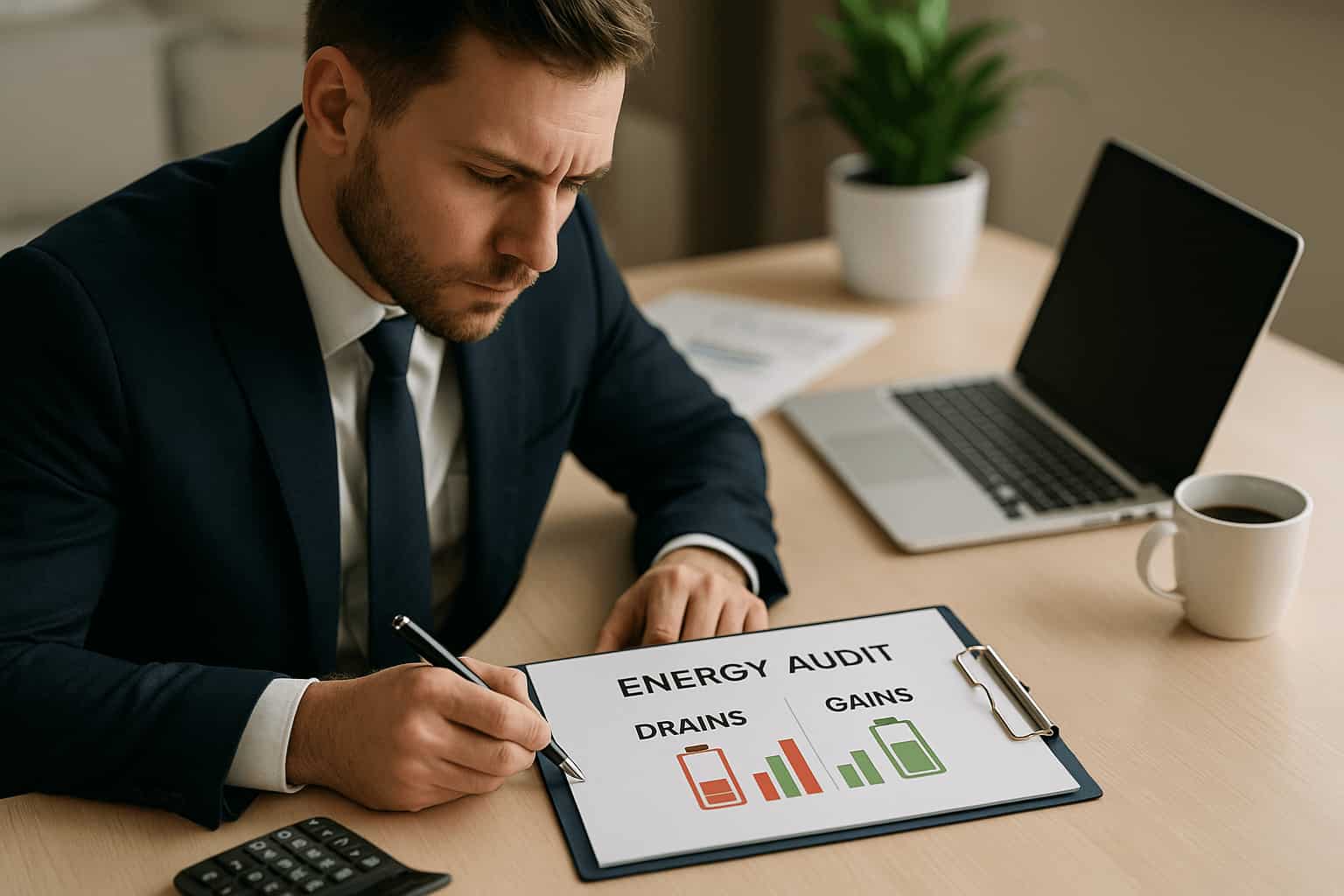
One of the most powerful tools for effective energy management is conducting a comprehensive energy audit—a systematic analysis of activities, environments, and interactions that either deplete or restore your energy reserves. This process, adapted from business energy auditing practices, provides introverts with concrete data about their energy patterns and forms the foundation for developing personalized management strategies.
The Framework for Energy Assessment
An effective energy audit examines three primary categories: environmental factors, social interactions, and work activities. Each category contains multiple subcategories that can be evaluated on a scale from highly draining (-3) to highly energizing (+3), with neutral activities scoring zero. This quantitative approach helps identify patterns that might not be obvious through casual observation.
Environmental factors include physical workspace characteristics such as noise levels, lighting, privacy, and visual stimulation. Open offices with high ambient noise might score -2 or -3 for most introverts, while private offices with natural lighting might score +2 or +3. The key is recognizing that environmental factors have cumulative effects throughout the day—a moderately draining environment (-1) can become significantly problematic over an eight-hour period.
Social interactions encompass the full spectrum of professional relationships and communication modes. Large group meetings might consistently score -2 or -3, while one-on-one mentoring conversations might score +1 or +2. The audit should also consider the timing and context of interactions—the same conversation might be energizing in the morning when energy reserves are high but draining in the afternoon when reserves are depleted.
Work activities include both the content and structure of professional tasks. Deep analytical work might score +2 or +3 for many introverts, while rapid-fire customer service interactions might score -2 or -3. The audit should distinguish between the inherent nature of the work and the conditions under which it’s performed—strategic planning might be energizing when done independently but draining when conducted in large group brainstorming sessions.
Data Collection Methods
Effective energy auditing requires systematic data collection over a sufficient period to identify reliable patterns. A minimum of two weeks is recommended, with four weeks providing more robust data that accounts for cyclical variations in workload and energy levels.
Real-time tracking involves briefly noting energy levels and activities throughout the day, ideally at two-hour intervals. This approach captures immediate energy impacts and helps identify specific triggers that might be forgotten by the end of the day. Simple smartphone apps or even basic note-taking can support this process without creating additional energy drain through complex tracking systems.
End-of-day reflection provides an opportunity to assess overall energy patterns and identify the most significant drains and gains from each day. This reflection should consider not only what happened but also the sequence and timing of activities—energy-draining activities early in the day may have different impacts than the same activities later when reserves are already depleted.
Weekly pattern analysis helps identify broader trends and cyclical patterns that might not be apparent from daily tracking alone. Many introverts find that their energy patterns vary significantly between different days of the week, with Mondays requiring different management strategies than Fridays, for example.
Identifying Hidden Energy Drains

The audit process often reveals energy drains that weren’t previously recognized or understood. These hidden drains can be particularly problematic because they operate below conscious awareness while consistently depleting energy reserves.
Transition costs represent the energy required to shift between different types of activities or environments. For introverts, these costs can be significant—moving from solitary focused work to a team meeting might require substantial energy for mental and social adjustment, even if both activities are individually manageable. Recognizing these transition costs allows for better scheduling and preparation strategies.
Anticipatory energy drain occurs when introverts expend energy worrying about or preparing for upcoming challenging interactions. A networking event scheduled for later in the week might create ongoing energy drain through anticipatory anxiety, even before the event occurs. Identifying these patterns allows for more effective preparation and anxiety management strategies.
Recovery debt accumulates when introverts don’t allow sufficient time for energy restoration between demanding activities. This debt compounds over time and can lead to chronic energy depletion even when individual activities seem manageable. The audit helps identify when recovery time is insufficient and how this impacts subsequent performance.
Discovering Energy Gains and Multipliers
While much attention focuses on energy drains, the audit process also reveals activities and conditions that actively restore or multiply energy. Understanding these gains is crucial for developing sustainable energy management strategies.
Flow state activities are those that not only avoid energy drain but actually generate energy through deep engagement and satisfaction. For many introverts, these might include complex problem-solving, strategic analysis, or creative work that allows for sustained focus and internal processing. Identifying and protecting time for these activities can provide significant energy benefits.
Relationship energizers are specific people or types of interactions that leave introverts feeling more energized rather than depleted. These might include mentoring relationships, collaborative work with trusted colleagues, or conversations with individuals who share similar communication styles and professional interests. Recognizing these relationships allows for strategic investment in connections that provide mutual benefit.
Environmental optimizers are physical or temporal conditions that enhance energy efficiency and effectiveness. Some introverts find that certain times of day, specific locations, or particular environmental conditions allow them to accomplish more with less energy expenditure. Identifying these optimizers enables better scheduling and workspace design decisions.
Creating Your Personal Energy Map
The ultimate goal of the energy audit is creating a personalized energy map that guides daily, weekly, and longer-term planning decisions. This map should identify your highest-drain activities, most effective restoration methods, and optimal conditions for different types of work.
The map becomes a decision-making tool for evaluating new opportunities, structuring your schedule, and advocating for working conditions that support your effectiveness. It also provides a framework for communicating your needs to supervisors and colleagues in professional, business-focused terms rather than personal preference language.
Regular updates to the energy map ensure it remains accurate as roles, responsibilities, and life circumstances change. What energizes or drains you may evolve over time, and the map should reflect these changes to maintain its effectiveness as a management tool.
5. Strategic Networking for Introverts: Quality Over Quantity

The traditional approach to professional networking—attending large events, meeting as many people as possible, and maintaining broad but shallow connections—fundamentally conflicts with introverted preferences and energy management needs. However, research consistently shows that professional networks are crucial for career advancement, with up to 85% of jobs filled through networking rather than public postings [8]. This creates a critical challenge: how can introverts build the professional relationships necessary for career success without depleting their energy reserves or compromising their authentic communication style?
The answer lies in strategic networking that leverages introverted strengths while working within natural energy constraints. This approach prioritizes relationship depth over breadth, focuses on mutual value creation rather than transactional exchanges, and utilizes communication channels that allow for thoughtful, prepared interactions.
The Depth-First Networking Strategy
Unlike extroverts who may thrive on maintaining large networks of casual professional acquaintances, introverts typically build more effective networks through deeper relationships with fewer individuals. This depth-first approach aligns with natural introverted preferences while often producing superior professional outcomes.
Relationship depth in professional networking means moving beyond surface-level connections to develop genuine understanding of others’ professional challenges, goals, and expertise areas. This deeper understanding enables more meaningful collaboration opportunities and creates stronger mutual support systems. For introverts, who naturally prefer substantial conversations over small talk, this approach feels more authentic and energizing.
Strategic relationship selection involves identifying individuals whose professional interests, expertise, or career trajectories align with your own goals and values. Rather than attempting to connect with everyone in your industry, focus on building relationships with people who can provide mutual learning opportunities, collaborative possibilities, or complementary skills and knowledge.
Long-term relationship investment recognizes that the most valuable professional relationships develop over months and years rather than through single interactions. This timeline suits introverted relationship-building preferences and allows for the gradual trust development that introverts both prefer and excel at creating.
The Preparation-Based Approach
One of the key advantages introverts have in networking is their natural inclination toward preparation and thoughtful communication. Leveraging this strength can transform networking from an energy-draining improvisation exercise into a more manageable, strategic activity.
Pre-event research allows introverts to identify specific individuals they want to connect with and prepare relevant conversation topics. This preparation reduces the cognitive load during actual networking interactions and provides confidence-building structure for conversations. Research might include reviewing attendee lists, identifying mutual connections, and preparing thoughtful questions about others’ work and interests.
Conversation frameworks provide structure for networking interactions, reducing the energy required for real-time social navigation. These frameworks might include prepared questions about industry trends, thoughtful inquiries about others’ professional challenges, or structured approaches for sharing your own expertise and interests. Having these frameworks available reduces anxiety and allows introverts to focus on genuine connection rather than conversation management.
Follow-up planning ensures that initial networking connections develop into meaningful professional relationships. Introverts often excel at thoughtful follow-up communication, which can differentiate them from extroverts who may make many initial connections but fail to develop them further. Planning specific follow-up actions before networking events ensures that valuable connections aren’t lost due to post-event energy depletion.
Alternative Networking Venues and Formats

Traditional networking events—large receptions with cocktails and small talk—represent just one approach to professional relationship building. Introverts often find greater success and energy efficiency through alternative networking formats that better align with their communication preferences and energy management needs.
Educational networking occurs through workshops, seminars, conferences, and professional development events where the primary focus is learning rather than socializing. These environments provide natural conversation starters through shared learning experiences and allow introverts to demonstrate their expertise through thoughtful questions and insights rather than social performance.
Project-based networking develops through collaborative work on professional projects, volunteer activities, or industry initiatives. This approach allows relationships to develop naturally through shared work rather than forced social interaction. The focus on accomplishing meaningful goals provides structure and purpose that many introverts find energizing rather than draining.
Mentorship networking involves both seeking mentors and providing mentorship to others. These relationships naturally align with introverted preferences for one-on-one, substantive conversations focused on professional development and knowledge sharing. Mentorship relationships also tend to develop over longer timeframes, allowing for the gradual trust-building that introverts prefer.
Leveraging Written Communication
Introverts often communicate more effectively through written channels than verbal ones, particularly when discussing complex or important topics. This strength can be strategically leveraged for networking purposes in ways that feel more natural and require less energy than traditional face-to-face networking.
Thoughtful email outreach allows introverts to craft carefully considered messages that demonstrate their expertise and genuine interest in others’ work. Unlike spontaneous conversation, written communication allows time for reflection, research, and articulation of ideas in ways that showcase introverted strengths.
Content creation and sharing through blogs, articles, social media posts, or industry publications can attract networking opportunities organically. When introverts share valuable insights through written content, they often find that others reach out to them, reversing the traditional networking dynamic and reducing the energy required for relationship initiation.
Online community participation in professional forums, industry groups, or specialized platforms allows for networking through asynchronous communication. These environments often reward thoughtful, well-researched contributions over quick responses, playing to introverted strengths while building professional visibility and relationships.
The Energy-Efficient Networking Calendar
Sustainable networking for introverts requires careful attention to timing, frequency, and energy management. Rather than attempting to maintain constant networking activity, successful introverts often develop cyclical approaches that allow for intensive networking periods followed by recovery and relationship maintenance phases.
Seasonal networking might involve concentrating networking activities during specific times of year when energy levels are higher or when industry events naturally cluster. This approach allows for more intensive relationship building during optimal periods while providing recovery time during other seasons.
Weekly networking rhythms recognize that energy levels vary throughout the week and schedule networking activities during peak energy periods. Many introverts find that networking early in the week, when energy reserves are highest, produces better outcomes than end-of-week activities when energy is depleted.
Recovery planning ensures that networking activities are followed by adequate restoration time. This might involve scheduling lighter workdays after networking events, planning solitary activities for evenings following social professional activities, or building buffer time around networking commitments to allow for preparation and recovery.
6. Digital Networking: Leveraging Technology for Authentic Connections

The digital revolution has fundamentally transformed professional networking, creating new opportunities that particularly benefit introverts. Online platforms and digital communication tools offer asynchronous interaction, reduced sensory stimulation, and the ability to craft thoughtful responses—all of which align with introverted preferences and energy management needs. Understanding how to leverage these digital tools effectively can provide introverts with significant networking advantages while requiring less energy than traditional face-to-face approaches.
The Asynchronous Advantage
One of the most significant benefits of digital networking for introverts is the ability to engage in asynchronous communication. Unlike real-time conversations that require immediate responses and continuous social energy, digital platforms allow for thoughtful consideration and response timing that aligns with individual energy patterns and processing preferences.
LinkedIn messaging exemplifies this advantage, allowing introverts to craft carefully considered outreach messages, respond to inquiries when energy levels are optimal, and maintain professional relationships through periodic, meaningful exchanges rather than constant interaction. The platform’s professional focus also eliminates much of the small talk that introverts often find draining, allowing conversations to center on substantive professional topics.
Email relationship building provides even greater flexibility for thoughtful communication. Introverts can take time to research recipients, craft personalized messages that demonstrate genuine interest and expertise, and respond to inquiries with well-considered, valuable insights. This approach often produces stronger professional relationships than quick, surface-level interactions common in traditional networking settings.
Online community engagement through industry forums, professional groups, and specialized platforms allows introverts to build reputation and relationships through consistent, valuable contributions over time. These environments reward depth of knowledge and thoughtful analysis—natural introverted strengths—rather than social performance or quick wit.
Platform-Specific Strategies
Different digital platforms offer unique advantages for introverted networking, and understanding how to leverage each platform’s strengths can maximize networking effectiveness while minimizing energy expenditure.
LinkedIn optimization begins with creating a comprehensive profile that showcases expertise and professional interests, allowing others to understand your value proposition without requiring direct explanation. Regular content sharing through articles, posts, or comments on others’ content can build professional visibility organically. The platform’s recommendation and endorsement features allow for relationship building through supportive actions rather than direct communication.
Twitter professional engagement can be particularly effective for introverts in knowledge-based industries. The platform’s character limits force concise communication, which can actually benefit introverts who prefer to distill ideas to their essence. Participating in industry Twitter chats or following and engaging with thought leaders can build professional relationships through shared intellectual interests rather than personal social connection.
Industry-specific platforms often provide more targeted networking opportunities with reduced noise and distraction. Platforms like GitHub for developers, Behance for designers, or ResearchGate for academics allow introverts to showcase their work and connect with others based on professional interests and expertise rather than general networking.
Content Creation as Networking

For introverts, creating and sharing valuable content can be one of the most effective networking strategies. This approach reverses traditional networking dynamics by attracting others to you rather than requiring you to actively seek out connections. Content creation also leverages introverted strengths in research, analysis, and thoughtful communication.
Thought leadership development through regular blog posts, articles, or social media content establishes expertise and attracts networking opportunities organically. When introverts consistently share valuable insights, industry peers often reach out to them, creating networking opportunities that feel more natural and require less energy than cold outreach.
Educational content sharing such as tutorials, case studies, or industry analysis provides value to others while demonstrating expertise. This approach builds professional relationships through mutual learning rather than transactional networking, creating more sustainable and meaningful connections.
Curated content commentary involves sharing others’ content with thoughtful analysis or additional insights. This approach allows introverts to engage with industry conversations and build relationships with content creators while adding their own valuable perspective to ongoing discussions.
Virtual Event Networking
The shift toward virtual and hybrid events has created new networking opportunities that can be more accessible and energy-efficient for introverts. Understanding how to navigate these digital environments effectively can provide significant professional benefits while working within natural energy constraints.
Pre-event preparation becomes even more important in virtual settings, where technical issues or unfamiliar platforms can create additional stress. Researching attendee lists, testing technology, and preparing conversation topics in advance can reduce anxiety and energy expenditure during actual events.
Strategic session selection allows introverts to focus their energy on the most valuable networking opportunities rather than attempting to participate in all available activities. Choosing smaller breakout sessions over large general sessions, or selecting topic-specific discussions over broad networking mixers, can provide better networking outcomes with less energy investment.
Follow-up optimization is often easier in virtual settings, where contact information is readily available and initial conversations can be referenced through chat logs or session recordings. This allows introverts to craft thoughtful follow-up messages that reference specific conversation points and demonstrate genuine interest in continued professional relationship development.
Building Digital Relationship Depth
While digital networking offers many advantages for introverts, building meaningful professional relationships still requires intentional effort and strategic approach. The key is leveraging digital tools to create the depth of connection that introverts naturally prefer while working within the constraints and opportunities of online communication.
Progressive relationship development involves gradually deepening digital relationships through increasingly substantial interactions. This might begin with social media engagement, progress to direct messaging or email exchanges, and eventually include video calls or collaborative projects. This progression allows relationships to develop naturally while respecting both parties’ communication preferences and energy constraints.
Value-first communication focuses on providing genuine value in every interaction rather than seeking immediate benefit. This approach aligns with introverted preferences for meaningful exchange and often produces stronger, more sustainable professional relationships than transactional networking approaches.
Consistency over intensity recognizes that digital relationship building benefits from regular, moderate engagement rather than sporadic intensive interaction. This approach allows introverts to maintain professional relationships without overwhelming their energy reserves or creating unsustainable communication commitments.
The digital networking landscape continues to evolve, with new platforms and tools regularly emerging. For introverts, staying informed about these developments and experimenting with new approaches can provide ongoing advantages in building and maintaining professional relationships while honoring natural energy management needs and communication preferences.
7. Remote Work Revolution: How Introverts Can Thrive in Distributed Teams

The widespread adoption of remote and hybrid work models represents one of the most significant workplace transformations in recent history, and this shift has created unprecedented opportunities for introverts to excel professionally. Research indicates that introverts are twice as likely to dread returning to traditional office environments compared to extroverts, and remote work arrangements often allow introverts to optimize their energy management while leveraging their natural strengths [9].
However, thriving in remote work environments requires more than simply working from home. Success depends on understanding how to structure remote work for optimal energy management, building effective relationships in distributed teams, and navigating the unique challenges that remote work can present for professional development and career advancement.
The Energy Optimization Opportunity
Remote work provides introverts with unprecedented control over their work environment, schedule, and social interactions—all critical factors in effective energy management. This control allows for optimization strategies that would be impossible in traditional office settings.
Environmental customization enables introverts to create workspaces that support rather than drain their energy. This might involve controlling noise levels, lighting, visual stimulation, and interruption patterns in ways that align with individual preferences and energy needs. The ability to work in a quiet, private space can significantly reduce the baseline energy expenditure required simply to maintain focus and productivity.
Schedule optimization allows introverts to align their most demanding work with their peak energy periods while scheduling lower-energy activities during natural energy dips. Many introverts find they can accomplish more high-quality work in fewer hours when they have control over their schedule and work environment, leading to both improved performance and better work-life integration.
Interaction management provides the ability to structure social and collaborative activities in ways that support rather than deplete energy reserves. This might involve batching meetings into specific time blocks, scheduling buffer time before and after demanding interactions, or choosing communication channels that align with energy levels and processing preferences.
Leveraging Introverted Strengths in Remote Settings
Remote work environments often reward many of the natural strengths that introverts bring to professional settings. Understanding how to leverage these strengths can provide significant competitive advantages in distributed teams.
Deep work capabilities become particularly valuable in remote settings where sustained focus and independent problem-solving are essential. Introverts’ natural preference for uninterrupted work periods aligns perfectly with remote work’s reduced interruption patterns, often leading to higher productivity and better quality output compared to traditional office environments.
Written communication excellence provides significant advantages in remote teams that rely heavily on asynchronous communication. Introverts’ preference for thoughtful, well-crafted written communication often translates to clearer project documentation, more effective email communication, and better virtual collaboration outcomes.
Independent work preferences align naturally with remote work’s emphasis on self-direction and autonomous task management. Introverts who are comfortable working independently often adapt more quickly to remote work expectations and may require less management oversight than colleagues who prefer constant social interaction and feedback.
Building Relationships in Distributed Teams

While remote work offers many advantages for introverts, building and maintaining professional relationships in distributed teams requires intentional strategies that account for the reduced informal interaction opportunities that traditional offices provide.
Structured relationship building involves creating regular, purposeful interactions with colleagues and supervisors that go beyond immediate task requirements. This might include scheduling regular one-on-one check-ins, participating in virtual coffee chats, or engaging in structured team-building activities that feel authentic and valuable rather than forced or superficial.
Asynchronous relationship investment leverages introverts’ strengths in thoughtful communication to build relationships through meaningful written exchanges. This might involve sharing relevant articles with colleagues, providing thoughtful feedback on others’ work, or contributing valuable insights to team discussions through channels that allow for careful consideration and articulation.
Project-based collaboration creates opportunities for relationship building through shared work rather than purely social interaction. Introverts often find it easier to connect with colleagues through collaborative problem-solving, knowledge sharing, or working together toward common professional goals rather than through casual social conversation.
Navigating Remote Work Challenges
Despite its many advantages, remote work can present unique challenges for introverts, particularly around visibility, career advancement, and maintaining professional networks. Addressing these challenges proactively is essential for long-term career success in remote environments.
Visibility management requires intentional effort to ensure that contributions and achievements are recognized in environments where informal recognition opportunities are reduced. This might involve regular progress updates to supervisors, documentation of achievements and impact, or strategic participation in high-visibility projects and initiatives.
Career development planning becomes more important in remote settings where informal mentorship and advancement opportunities may be less apparent. Introverts may need to be more proactive in seeking feedback, identifying development opportunities, and advocating for career advancement in environments where these conversations don’t happen naturally through casual office interactions.
Network maintenance requires systematic approaches to maintaining professional relationships that might otherwise be sustained through informal office interactions. This might involve regular check-ins with professional contacts, participation in virtual industry events, or strategic engagement with professional communities and organizations.
Hybrid Work Optimization
Research indicates that 74% of introverts prefer hybrid work arrangements rather than fully remote work, suggesting that the optimal approach for many introverts involves strategic combination of remote and in-office work [10]. Understanding how to optimize hybrid arrangements can provide the benefits of both work modes while minimizing their respective challenges.
Strategic office presence involves being intentional about when and why to work in office settings. This might mean scheduling office days around important meetings, collaborative projects, or relationship-building activities while reserving remote days for deep work, individual projects, or energy recovery.
Energy-aware scheduling recognizes that in-office days typically require more energy and plans accordingly. This might involve lighter schedules on office days, recovery time after intensive in-person interactions, or strategic sequencing of remote and office work to optimize overall energy management.
Boundary management becomes particularly important in hybrid arrangements where the lines between different work modes can become blurred. Clear boundaries around availability, communication expectations, and work-life integration help maintain the energy management benefits that make remote work valuable for introverts.
Technology and Tool Optimization
Success in remote and hybrid work environments depends heavily on effective use of technology and digital tools. For introverts, choosing and optimizing these tools can significantly impact energy management and professional effectiveness.
Communication channel selection involves choosing the right communication method for different types of interactions. This might mean using asynchronous tools like email or project management platforms for routine communication while reserving video calls for high-priority discussions that benefit from real-time interaction.
Meeting optimization includes strategies for making virtual meetings more energy-efficient and effective. This might involve advocating for agenda-driven meetings, using chat features to contribute when verbal participation is challenging, or scheduling meetings during peak energy periods while protecting deep work time.
Productivity tool integration can help introverts manage their energy and attention more effectively in remote settings. This might include time-blocking tools, distraction management applications, or project management systems that support the structured, organized approach that many introverts prefer.
The remote work revolution has created unprecedented opportunities for introverts to design work arrangements that support their natural strengths while managing their energy effectively. However, realizing these benefits requires intentional strategy and ongoing optimization rather than simply working from home. Introverts who approach remote work strategically often find they can achieve higher levels of professional success and job satisfaction than would be possible in traditional office environments.
8. Building Professional Relationships Without Burning Out

Professional relationship building is essential for career success, yet traditional approaches often conflict with introverted energy management needs and communication preferences. The challenge isn’t avoiding professional relationships—research consistently shows they’re crucial for career advancement—but rather developing sustainable approaches that build meaningful connections without depleting energy reserves or compromising authenticity.
Successful relationship building for introverts requires understanding the difference between networking and relationship development, leveraging natural introverted strengths in one-on-one interactions, and creating systems that maintain professional connections without constant energy investment.
The Relationship Development Mindset
The fundamental shift from networking to relationship development changes both the approach and energy requirements of professional connection building. While networking often focuses on meeting many people quickly and maintaining broad but shallow connections, relationship development prioritizes depth, mutual value creation, and long-term professional partnership.
Mutual value focus transforms professional interactions from transactional exchanges to collaborative partnerships. Instead of approaching relationships with a focus on what you can gain, the emphasis shifts to understanding others’ professional challenges and identifying ways to provide genuine value. This approach feels more authentic to introverts and often produces stronger, more sustainable professional relationships.
Long-term perspective recognizes that the most valuable professional relationships develop over months and years rather than through single interactions. This timeline aligns with introverted preferences for gradual trust building and allows relationships to develop naturally through shared experiences and mutual support rather than forced social interaction.
Quality over quantity acknowledges that introverts typically build more effective professional networks through deeper relationships with fewer individuals rather than broad networks of casual acquaintances. This approach is not only more sustainable from an energy management perspective but often produces better professional outcomes through stronger mutual support and collaboration.
Strategic Relationship Investment
Effective relationship building for introverts requires strategic thinking about where to invest limited social energy for maximum professional benefit. This involves identifying key relationships, understanding different relationship types, and developing sustainable maintenance strategies.
Relationship mapping involves identifying the types of professional relationships that are most important for your career goals and current professional needs. This might include mentors who can provide guidance and advocacy, peers who can offer collaboration opportunities and mutual support, industry experts who can provide specialized knowledge, and junior colleagues who can benefit from your expertise while providing fresh perspectives.
Investment prioritization recognizes that not all professional relationships require the same level of energy investment. Core relationships that directly impact your work or career development may warrant regular, substantial investment, while peripheral relationships might be maintained through periodic, lower-energy interactions such as social media engagement or occasional email exchanges.
Relationship lifecycle management understands that professional relationships naturally evolve over time and that investment strategies should adapt accordingly. New relationships may require more intensive energy investment during the initial trust-building phase, while established relationships may be maintained through less frequent but meaningful interactions.
Energy-Efficient Relationship Building Strategies
Building professional relationships doesn’t have to be energy-draining if approached strategically. Several techniques can help introverts build meaningful professional connections while working within their natural energy constraints and communication preferences.
One-on-one optimization leverages introverts’ natural strength in deeper, individual conversations. Rather than attempting to build relationships in group settings, focus on scheduling individual coffee meetings, lunch conversations, or structured one-on-one discussions. These interactions typically require less energy while allowing for more meaningful connection and mutual understanding.
Structured interaction frameworks provide conversation guides that reduce the cognitive load of relationship building while ensuring productive outcomes. This might involve preparing specific questions about others’ professional challenges, sharing relevant resources or insights, or discussing industry trends and developments. Having these frameworks available reduces anxiety and allows focus on genuine connection rather than conversation management.
Activity-based relationship building creates connections through shared professional activities rather than purely social interaction. This might involve collaborating on projects, attending educational events together, participating in professional organizations, or engaging in volunteer activities related to your industry. These approaches allow relationships to develop naturally through shared goals and experiences.
Leveraging Written Communication for Relationship Building

Introverts often communicate more effectively through written channels, particularly when discussing complex or important topics. This strength can be strategically leveraged for relationship building in ways that feel more natural and require less energy than traditional face-to-face approaches.
Thoughtful follow-up communication after meetings or professional interactions can significantly strengthen relationships while playing to introverted strengths. This might involve sending summary emails that capture key discussion points, sharing relevant resources that address topics discussed, or providing additional insights that occurred after the initial conversation.
Value-added sharing involves regularly sharing relevant articles, insights, or opportunities with professional contacts based on their interests and needs. This approach maintains relationship visibility while providing genuine value, creating positive associations with your professional brand and expertise.
Collaborative writing projects such as co-authored articles, joint research initiatives, or shared content creation can build strong professional relationships through intellectual collaboration rather than social interaction. These projects often produce tangible professional benefits while allowing relationships to develop through shared work and mutual expertise.
Maintaining Relationships Systematically
Sustainable relationship maintenance requires systems that ensure important professional connections are nurtured without creating overwhelming social obligations or constant energy drain.
Relationship maintenance calendars provide structured approaches to staying in touch with professional contacts without relying on memory or spontaneous social energy. This might involve quarterly check-ins with key mentors, monthly updates to important peers, or annual reconnection with broader professional networks.
Batch relationship activities group similar relationship maintenance tasks together to minimize energy expenditure and maximize efficiency. This might involve scheduling all one-on-one meetings during specific weeks, batching follow-up communications, or dedicating specific time periods to relationship maintenance activities.
Systematic value provision involves regularly identifying ways to provide value to professional contacts through introductions, resource sharing, or expertise provision. Having systems for identifying and acting on these opportunities ensures that relationships remain mutually beneficial without requiring constant attention or energy investment.
Boundary Management in Professional Relationships
Effective relationship building for introverts requires clear boundaries that protect energy reserves while maintaining professional connections. These boundaries should be professional and respectful while ensuring sustainable relationship management.
Availability boundaries involve setting clear expectations about communication preferences, response times, and meeting availability. This might include preferences for email over phone calls, specific times for meetings or calls, or advance notice requirements for social or networking events.
Energy investment boundaries recognize that different relationships require different levels of energy investment and that these investments should align with professional priorities and personal energy management needs. This involves being strategic about which events to attend, which meetings to prioritize, and how much social energy to invest in different professional relationships.
Authenticity boundaries ensure that relationship building approaches align with personal values and communication preferences rather than attempting to adopt extroverted relationship building styles that feel inauthentic or unsustainable. This might involve focusing on professional rather than personal topics, preferring structured over unstructured interactions, or emphasizing expertise sharing over social bonding.
Building professional relationships as an introvert requires intentional strategy and systematic approach, but it doesn’t require becoming more extroverted or depleting energy reserves through unsustainable social performance. By leveraging natural introverted strengths and working within energy management constraints, introverts can build strong, valuable professional networks that support long-term career success while maintaining personal authenticity and wellbeing.
9. Leadership Strategies for Introverted Professionals
The persistent myth that effective leadership requires extroverted traits has created significant barriers for introverted professionals seeking leadership roles. However, recent research reveals that introverted leaders actually drive 28% higher productivity from proactive, engaged teams compared to their extroverted counterparts [11]. This performance advantage stems from introverts’ natural strengths in listening, strategic thinking, and empowering others—all crucial leadership capabilities that are often undervalued in traditional leadership development approaches.
Understanding how to leverage these natural strengths while managing the energy demands of leadership roles is essential for introverted professionals who aspire to leadership positions or who find themselves in leadership roles without adequate preparation for the unique challenges they present.
The Quiet Leadership Advantage
Introverted leaders bring distinct advantages to organizations, particularly in complex, rapidly changing business environments that require thoughtful decision-making and strategic thinking. These advantages often become more apparent over time as the results of quiet leadership approaches compound.
Strategic thinking depth allows introverted leaders to analyze complex situations thoroughly before making decisions. While extroverted leaders might make quick decisions based on immediate information, introverted leaders typically gather more comprehensive data, consider multiple perspectives, and anticipate potential consequences more thoroughly. This approach often leads to better long-term outcomes, even if it appears slower in the short term.
Active listening capabilities enable introverted leaders to understand their teams’ needs, concerns, and ideas more completely. This deeper understanding often translates to better employee engagement, more effective problem-solving, and stronger team cohesion. Employees frequently report feeling more heard and valued by introverted leaders who take time to truly understand their perspectives.
Empowerment-focused leadership naturally emerges from introverts’ preference for working through others rather than being the center of attention. Introverted leaders often excel at developing their team members’ capabilities, delegating meaningful responsibilities, and creating environments where others can shine. This approach builds stronger, more capable teams while reducing the energy demands on the leader.
Energy Management in Leadership Roles
Leadership positions typically involve high levels of social interaction, public visibility, and decision-making responsibility—all of which can be particularly draining for introverts. Developing effective energy management strategies is crucial for sustainable leadership performance.
Strategic calendar management involves structuring leadership schedules to optimize energy usage while meeting role requirements. This might include batching similar activities together, scheduling high-energy leadership activities during peak energy periods, and building in recovery time after particularly demanding interactions or events.
Delegation for energy optimization goes beyond traditional delegation to consider the energy impact of different leadership activities. Tasks that are particularly draining for introverted leaders—such as large group presentations or high-conflict negotiations—might be delegated to team members who find these activities energizing, while the leader focuses on activities that leverage their natural strengths.
Preparation-based leadership leverages introverts’ natural inclination toward thorough preparation to reduce the energy required for leadership activities. Well-prepared leaders typically feel more confident and require less energy for improvisation during meetings, presentations, or difficult conversations.
Communication Strategies for Introverted Leaders
Effective leadership communication for introverts often requires different approaches than those typically taught in leadership development programs, which tend to emphasize extroverted communication styles. Understanding how to communicate effectively while honoring introverted preferences can significantly improve leadership effectiveness.
One-on-one leadership emphasis recognizes that introverted leaders often communicate most effectively in individual settings rather than large group environments. Regular one-on-one meetings with team members, stakeholders, and peers can provide opportunities for deeper communication and relationship building while requiring less energy than large group interactions.
Written communication leverage allows introverted leaders to utilize their strength in thoughtful, well-crafted written communication for complex or important leadership messages. This might involve follow-up emails that clarify meeting discussions, detailed project communications that provide clear direction, or strategic memos that articulate vision and priorities.
Structured meeting leadership provides frameworks that help introverted leaders facilitate effective group discussions while managing their energy efficiently. This might include detailed agendas, pre-distributed materials that allow for preparation, and structured discussion formats that ensure productive outcomes while reducing the energy required for real-time group facilitation.
Building Leadership Presence as an Introvert
Leadership presence—the ability to inspire confidence and influence others—can be developed by introverts in ways that align with their natural strengths rather than requiring adoption of extroverted behaviors that feel inauthentic and energy-draining.
Expertise-based presence builds influence through demonstrated knowledge, strategic insight, and problem-solving capability rather than charismatic personality or social performance. Introverted leaders often build strong followership by consistently providing valuable insights, making thoughtful decisions, and demonstrating deep understanding of complex business challenges.
Authentic relationship presence develops through genuine connections with team members and stakeholders based on mutual respect and trust rather than social charm or entertainment value. This approach often produces stronger, more sustainable leadership relationships while feeling more natural and requiring less energy for introverted leaders.
Consistent reliability presence establishes leadership credibility through dependable performance, thoughtful communication, and steady decision-making rather than dramatic gestures or high-energy motivation. This approach builds trust over time and often produces more stable, effective leadership outcomes.
Team Development and Empowerment
Introverted leaders often excel at developing others’ capabilities and creating high-performing teams through empowerment rather than direct control. This approach aligns with introverted preferences while often producing superior team performance outcomes.
Individual development focus involves investing significant time and energy in understanding each team member’s strengths, development needs, and career aspirations. This one-on-one approach allows introverted leaders to build strong relationships while helping team members reach their full potential.
Collaborative decision-making leverages team members’ expertise and perspectives to make better decisions while reducing the energy burden on the leader. This approach often produces better outcomes while building team engagement and capability.
Systems and process leadership focuses on creating effective organizational systems and processes that enable team success rather than relying on constant personal intervention and motivation. This approach allows introverted leaders to have significant impact while working within their energy constraints.
Managing Up as an Introverted Leader
Introverted leaders often face unique challenges in managing relationships with their own supervisors and senior leadership, particularly in organizations that favor extroverted leadership styles. Developing effective strategies for these relationships is crucial for career advancement and organizational effectiveness.
Strategic communication planning involves preparing thoroughly for interactions with senior leadership, focusing on key messages and anticipated questions. This preparation allows introverted leaders to communicate more effectively while reducing anxiety and energy expenditure during high-stakes conversations.
Results-focused reporting emphasizes concrete achievements and strategic insights rather than personal promotion or social relationship building. This approach often resonates well with senior leadership while feeling more authentic and sustainable for introverted leaders.
Influence through expertise builds senior leadership relationships through demonstrated competence and valuable insights rather than social networking or political maneuvering. This approach often produces more sustainable influence while aligning with introverted strengths and preferences.
10. Creating Sustainable Career Growth While Honoring Your Nature
Long-term career success for introverts requires strategies that work with, rather than against, natural energy patterns and communication preferences. This means developing career advancement approaches that leverage introverted strengths while managing the energy demands of professional growth. The goal isn’t to become more extroverted but to create career trajectories that allow for authentic success while maintaining personal wellbeing and energy sustainability.
Redefining Career Success Metrics
Traditional career success metrics often emphasize visibility, networking breadth, and extroverted leadership behaviors that may not align with introverted strengths or sustainable energy management. Developing personalized success metrics that honor introverted values while achieving professional goals is essential for long-term satisfaction and effectiveness.
Impact-focused success measures career advancement through the quality and significance of contributions rather than visibility or social recognition. This might involve focusing on projects that create substantial value, developing expertise that becomes organizationally critical, or building systems and processes that have lasting impact. These approaches often produce more sustainable satisfaction for introverts while creating genuine career advancement opportunities.
Expertise-based advancement builds career progression through deep knowledge development and specialized skills rather than broad networking or general management capabilities. This approach aligns with introverts’ natural preference for depth over breadth while creating valuable professional differentiation that supports career growth.
Relationship quality metrics evaluate professional network effectiveness through the depth and mutual value of key relationships rather than the total number of professional connections. This approach recognizes that introverts often build more effective professional support through fewer, stronger relationships that provide better career guidance, collaboration opportunities, and advancement support.
Strategic Career Planning for Energy Sustainability
Sustainable career growth requires intentional planning that considers energy management alongside traditional career development factors. This involves evaluating opportunities not just for their advancement potential but for their alignment with energy patterns and long-term sustainability.
Energy-aligned role selection involves evaluating career opportunities based on their energy requirements and alignment with natural introverted strengths. This might mean prioritizing roles that emphasize strategic thinking over constant social interaction, individual contribution over team management, or expertise development over broad relationship building. The goal is finding advancement opportunities that energize rather than drain.
Gradual responsibility expansion recognizes that introverts often perform better when they can gradually adapt to increased responsibility rather than taking on dramatically different roles that require sudden energy pattern changes. This approach might involve seeking stretch assignments that build on existing strengths, gradually increasing leadership responsibilities, or developing new skills in low-pressure environments before applying them in high-stakes situations.
Recovery and restoration planning builds energy management considerations into career planning, ensuring that periods of intensive growth or high-demand roles are balanced with opportunities for restoration and consolidation. This might involve alternating between high-visibility projects and behind-the-scenes work, or planning sabbaticals or lower-intensity periods following major career transitions.
Building Professional Brand as an Introvert
Developing a strong professional brand doesn’t require constant self-promotion or extroverted networking. Introverts can build powerful professional reputations through consistent value delivery, thoughtful expertise sharing, and strategic relationship building that aligns with their natural communication preferences.
Expertise-based branding focuses on becoming known for specific knowledge, skills, or insights rather than general leadership or networking ability. This approach involves consistently sharing valuable expertise through appropriate channels, developing reputation for thoughtful analysis and problem-solving, and becoming a go-to resource for specific types of challenges or opportunities.
Content-driven visibility leverages introverts’ strength in written communication to build professional visibility through articles, blog posts, research reports, or other content that demonstrates expertise and provides value to others. This approach allows for thoughtful, prepared communication while building professional reputation organically.
Mentorship and development branding builds professional reputation through consistent investment in others’ development and success. This approach aligns with many introverts’ natural inclination toward one-on-one relationship building while creating positive professional associations and expanding influence through others’ success.
Navigating Organizational Politics Authentically
Organizational politics are often unavoidable in career advancement, but introverts can navigate these dynamics in ways that feel authentic while protecting their energy and values. The key is understanding political dynamics without necessarily engaging in traditional political behaviors.
Information-based influence builds political effectiveness through superior understanding of organizational dynamics, strategic priorities, and stakeholder needs rather than through social manipulation or alliance building. This approach involves careful observation, strategic listening, and thoughtful analysis of organizational patterns and priorities.
Value-driven positioning involves aligning personal career goals with organizational needs and values rather than engaging in competitive political maneuvering. This approach often produces more sustainable political success while feeling more authentic and requiring less energy than traditional political strategies.
Strategic alliance building focuses on developing mutually beneficial relationships with key stakeholders based on shared professional interests and complementary capabilities rather than social networking or transactional exchanges. These alliances often provide better political support while aligning with introverted relationship building preferences.
Managing Career Transitions
Career transitions—whether promotions, role changes, or organization changes—can be particularly challenging for introverts due to the energy demands of adapting to new environments, building new relationships, and learning new systems. Developing effective transition strategies is crucial for sustainable career growth.
Preparation-intensive transitions leverage introverts’ natural inclination toward thorough preparation to reduce the energy and anxiety associated with career changes. This might involve extensive research about new roles or organizations, preparation of transition plans that address potential challenges, and development of support systems before transitions occur.
Gradual integration strategies recognize that introverts often adapt more effectively to new environments when they can integrate gradually rather than through immediate full engagement. This might involve starting with smaller, lower-risk interactions before engaging in high-visibility activities, or focusing on building a few key relationships before attempting broader networking.
Energy management during transitions acknowledges that career transitions typically require additional energy and plans accordingly. This might involve reducing other energy commitments during transition periods, building in extra recovery time, or seeking additional support during particularly demanding transition phases.
Long-term Career Sustainability
Creating sustainable career growth requires thinking beyond immediate advancement opportunities to consider long-term energy management, skill development, and personal satisfaction. This involves building careers that can be sustained over decades rather than optimizing for short-term gains that might lead to eventual burnout.
Skill development alignment focuses on building capabilities that leverage and enhance natural introverted strengths rather than attempting to develop skills that work against natural preferences. This might involve deepening analytical capabilities, developing expertise in complex problem-solving, or building advanced written communication skills.
Role evolution planning anticipates how career roles might evolve over time and prepares for these changes in ways that maintain energy sustainability. This might involve gradually building leadership capabilities, developing expertise that remains valuable as roles change, or creating flexibility that allows for role adaptation without complete career reinvention.
Legacy and impact focus considers the long-term impact and meaning of career choices rather than focusing solely on immediate advancement or recognition. This approach often provides more sustainable motivation and satisfaction for introverts while creating career trajectories that align with deeper values and purposes.
11. Practical Tools and Techniques for Daily Energy Management
Effective energy management for introverts requires practical, implementable tools that can be integrated into daily work routines without creating additional complexity or energy drain. These tools should be simple enough to use consistently while being sophisticated enough to address the nuanced energy patterns that introverts experience throughout their professional lives.
The Daily Energy Planning System
A systematic approach to daily energy planning helps introverts optimize their productivity while maintaining sustainable energy levels throughout the workday. This system involves three key components: morning energy assessment, strategic task scheduling, and evening reflection and planning.
Morning energy assessment involves briefly evaluating your energy level at the start of each day and adjusting your schedule accordingly. This might involve rating your energy on a simple 1-10 scale and then modifying your planned activities based on available energy reserves. High-energy days might be scheduled with demanding meetings or challenging projects, while lower-energy days might focus on routine tasks or individual work that requires less social interaction.
Strategic task scheduling aligns different types of work activities with natural energy patterns throughout the day. Many introverts find they have peak energy in the morning for complex, analytical work, moderate energy in early afternoon for meetings and collaboration, and lower energy later in the day for routine tasks and administrative work. Understanding and working with these patterns can significantly improve both productivity and energy sustainability.
Evening reflection and planning provides an opportunity to assess the day’s energy patterns, identify what worked well or poorly, and adjust the following day’s schedule based on lessons learned. This reflection might involve noting which activities were more or less draining than expected, identifying successful energy management strategies, and planning recovery activities for the following day if needed.
The Energy Audit Toolkit
Regular energy auditing helps introverts identify patterns and optimize their energy management strategies over time. This toolkit includes simple tracking methods, analysis frameworks, and adjustment strategies that can be implemented without significant time investment.
Simple tracking methods might include smartphone apps that send periodic energy level reminders, basic spreadsheets that track energy levels and activities, or even simple paper-based logs that can be completed quickly throughout the day. The key is finding a tracking method that provides useful data without becoming an energy drain itself.
Pattern analysis frameworks help identify trends and relationships in energy data that might not be obvious from day-to-day experience. This might involve weekly reviews that identify which types of activities consistently drain or restore energy, monthly analyses that reveal longer-term patterns, or seasonal assessments that account for cyclical variations in energy levels.
Adjustment strategies provide systematic approaches for modifying work patterns based on energy audit results. This might involve gradually shifting the timing of certain activities, experimenting with different approaches to challenging tasks, or implementing new recovery strategies based on identified energy patterns.
Communication and Boundary Tools
Effective communication about energy needs and work preferences is essential for creating sustainable work environments. These tools help introverts communicate their needs professionally while maintaining positive relationships with colleagues and supervisors.
Professional communication scripts provide language for discussing energy management needs in business-appropriate terms. Rather than describing personal preferences or limitations, these scripts focus on productivity optimization and work effectiveness. For example, requesting morning meetings for complex discussions because “I’m most analytically sharp in the morning” rather than “I’m too tired for difficult conversations in the afternoon.”
Boundary setting frameworks help establish clear expectations about availability, communication preferences, and work style needs without appearing uncooperative or difficult. This might involve proactively communicating preferred communication channels, setting expectations about response times, or requesting specific types of meeting structures that support effective participation.
Advocacy strategies provide approaches for requesting accommodations or modifications that support energy management without requiring disclosure of personal information or appearing to seek special treatment. These strategies focus on business benefits and productivity improvements rather than personal needs or preferences.
Technology and Environment Optimization
Strategic use of technology and environmental modifications can significantly reduce energy expenditure while improving work effectiveness. These optimizations often require minimal investment while providing substantial energy management benefits.
Digital communication optimization involves configuring technology tools to support rather than drain energy. This might include setting up email filters that prioritize important communications, using scheduling tools that batch similar activities together, or configuring notification settings that reduce interruptions during focused work periods.
Workspace customization creates physical environments that support energy management and productivity. This might involve noise-canceling headphones for open office environments, lighting adjustments that reduce eye strain and fatigue, or desk arrangements that minimize visual distractions and interruptions.
Productivity tool integration leverages technology to automate routine tasks and reduce cognitive load. This might include project management tools that track deadlines and priorities automatically, calendar applications that build in buffer time between meetings, or communication tools that allow for asynchronous collaboration and reduce meeting requirements.
Recovery and Restoration Techniques
Effective recovery strategies are essential for maintaining energy sustainability over time. These techniques should be practical enough to implement during busy work periods while being effective enough to provide genuine restoration.
Micro-recovery techniques provide brief energy restoration opportunities that can be implemented throughout the workday. This might include five-minute meditation breaks between meetings, brief walks outside during lunch periods, or quiet reflection time at the beginning or end of the workday.
Structured recovery planning involves intentionally scheduling recovery activities rather than hoping they will occur naturally. This might include blocking calendar time for individual work after intensive meetings, scheduling lighter workdays following particularly demanding periods, or planning weekend activities that provide genuine restoration rather than additional stimulation.
Emergency recovery protocols provide strategies for managing energy crises when normal management techniques aren’t sufficient. This might include having backup plans for particularly challenging days, knowing when and how to request schedule modifications, or having strategies for managing energy during unavoidable high-demand periods.
12. The Future of Work: Why Introverts Are Positioned for Success
The rapidly evolving workplace landscape is creating unprecedented opportunities for introverts to leverage their natural strengths and achieve professional success. Technological advances, changing organizational structures, and evolving work practices are shifting the competitive advantage toward many of the capabilities that introverts naturally possess. Understanding these trends and positioning yourself to capitalize on them can provide significant career advantages in the coming decades.
The Rise of Knowledge Work and Deep Thinking
The global economy’s continued shift toward knowledge-based work creates increasing demand for the deep thinking, analytical capabilities, and strategic insight that introverts naturally provide. As routine tasks become increasingly automated, the premium on complex problem-solving, creative analysis, and strategic thinking continues to grow.
Artificial intelligence collaboration is creating new opportunities for introverts who excel at working with complex systems and analyzing large amounts of information. As AI handles routine tasks, human workers increasingly focus on interpretation, strategy, and creative application of AI-generated insights—areas where introverted strengths in careful analysis and thoughtful consideration provide significant advantages.
Complex problem-solving demand continues to increase as organizations face more sophisticated challenges that require sustained analysis and creative thinking. The ability to work independently on complex problems, consider multiple perspectives, and develop innovative solutions becomes increasingly valuable in competitive business environments.
Strategic planning emphasis grows as organizations recognize the importance of long-term thinking and careful planning in rapidly changing markets. Introverts’ natural inclination toward thorough analysis and consideration of long-term consequences positions them well for strategic roles that are becoming increasingly critical for organizational success.
Digital Communication and Asynchronous Collaboration
The widespread adoption of digital communication tools and asynchronous collaboration methods plays directly to introverted strengths while reducing many of the energy drains associated with traditional workplace communication patterns.
Written communication primacy in digital work environments leverages introverts’ natural strength in thoughtful, well-crafted written communication. As organizations rely increasingly on email, messaging platforms, and collaborative documents, the ability to communicate effectively through writing becomes a significant competitive advantage.
Asynchronous collaboration benefits allow introverts to contribute to team projects and discussions on their own timeline, when their energy levels are optimal for thoughtful contribution. This shift away from real-time collaboration requirements enables introverts to provide their best thinking without the energy drain of constant synchronous interaction.
Global team integration creates opportunities for introverts to build professional relationships and contribute to projects across time zones and geographic boundaries. These distributed collaboration models often rely on structured communication and clear documentation—areas where introverted professionals typically excel.
The Distributed Work Revolution
Remote and hybrid work models are becoming permanent features of the professional landscape, creating work environments that often better align with introverted energy management needs and communication preferences.
Environment control advantages allow introverts to optimize their physical workspace for maximum productivity and minimum energy drain. The ability to control noise levels, interruptions, and social interactions provides significant benefits for introverted professionals who can now design work environments that support rather than hinder their effectiveness.
Flexible scheduling benefits enable introverts to align their most demanding work with their peak energy periods while scheduling lower-energy activities during natural energy dips. This optimization can lead to significant improvements in both productivity and job satisfaction.
Reduced commute and office politics eliminates many of the incidental energy drains associated with traditional office environments. The energy previously spent on commuting, office social interactions, and navigating workplace politics can be redirected toward productive work and professional development.
Leadership Evolution and Quiet Leadership Recognition
Organizational leadership models are evolving to recognize and value different leadership styles, including the quiet leadership approaches that introverts naturally employ. This shift creates new opportunities for introverted professionals to advance into leadership roles without compromising their authentic communication style.
Servant leadership emphasis aligns with introverts’ natural inclination toward empowering others and leading through support rather than dominance. As organizations recognize the effectiveness of servant leadership approaches, introverted leaders find more opportunities to advance while leveraging their natural strengths.
Data-driven decision making rewards the careful analysis and thorough consideration that introverted leaders typically bring to complex decisions. As organizations emphasize evidence-based leadership over charismatic decision-making, introverted leaders’ analytical strengths become increasingly valuable.
Employee engagement focus recognizes the importance of understanding and responding to individual team members’ needs—an area where introverted leaders’ listening skills and one-on-one relationship building capabilities provide significant advantages.
Technology-Enabled Networking and Relationship Building
Digital platforms and networking tools are creating new opportunities for professional relationship building that align better with introverted preferences and energy management needs.
Quality-focused networking platforms are emerging that emphasize meaningful professional connections over broad networking. These platforms often reward thoughtful engagement and expertise sharing rather than social performance, playing to introverted strengths in relationship building.
Content-based professional branding allows introverts to build professional reputation through expertise sharing and thought leadership rather than traditional networking and self-promotion. The ability to build influence through valuable content creation aligns well with introverted communication preferences.
Mentorship and coaching opportunities are expanding through digital platforms that connect professionals across geographic and organizational boundaries. These one-on-one relationship building opportunities align perfectly with introverted preferences while providing significant professional development benefits.
Preparing for Future Opportunities
Positioning yourself to capitalize on these trends requires strategic skill development and career planning that builds on introverted strengths while preparing for emerging opportunities.
Deep expertise development becomes increasingly valuable as organizations seek specialists who can navigate complex challenges in specific domains. Introverts’ natural inclination toward depth over breadth positions them well for developing the specialized expertise that commands premium value in knowledge-based economies.
Digital communication mastery involves developing sophisticated skills in written communication, virtual collaboration, and online relationship building. These skills build on natural introverted strengths while preparing for work environments that increasingly rely on digital interaction.
Strategic thinking capabilities can be developed through formal training, mentorship relationships, and practical experience with complex organizational challenges. As strategic thinking becomes increasingly valued, introverts who develop these capabilities position themselves for significant career advancement opportunities.
The future of work is creating an environment where introverted strengths are increasingly valued and where traditional barriers to introverted success are being reduced or eliminated. By understanding these trends and positioning yourself strategically, you can build a career that leverages your natural capabilities while contributing meaningfully to organizations and industries that are evolving to recognize and reward the unique value that introverts provide.
Conclusion
The professional landscape is undergoing fundamental changes that create unprecedented opportunities for introverts to thrive authentically while achieving significant career success. Rather than requiring introverts to adopt extroverted behaviors or compromise their natural energy management needs, the evolving workplace increasingly rewards the deep thinking, strategic analysis, and thoughtful communication that introverts naturally provide.
The key to success lies not in becoming more extroverted but in understanding how to leverage introverted strengths strategically while managing energy effectively. This involves developing personalized approaches to networking that prioritize relationship depth over breadth, creating work environments that support rather than drain energy reserves, and building career trajectories that align with natural preferences while achieving professional goals.
The research is clear: introverts who understand and work with their natural patterns rather than against them often achieve superior professional outcomes while maintaining better work-life integration and personal satisfaction. The strategies outlined in this guide provide a framework for creating sustainable professional success that honors your authentic self while meeting the demands of contemporary professional environments.
As the workplace continues to evolve toward distributed teams, digital communication, and knowledge-based work, the competitive advantages that introverts possess will only become more valuable. By implementing effective energy management strategies, building meaningful professional relationships, and positioning yourself strategically for emerging opportunities, you can create a career that not only succeeds by traditional metrics but also provides the deep satisfaction that comes from authentic professional expression.
The future belongs to professionals who can think deeply, communicate thoughtfully, and build meaningful relationships—exactly the strengths that introverts bring naturally to their work. The question isn’t whether introverts can succeed in professional environments, but rather how quickly organizations will recognize and leverage the unique value that introverted professionals provide.
References
[1] The Myers-Briggs Company. (2020). Global Sample Report: Personality Type Distribution. https://www.themyersbriggs.com/en-US/Products-and-Services/Myers-Briggs
[2] Dennison, K. (2024). “Why The Future Of Leadership Will Look To Introverts.” Forbes. https://www.forbes.com/sites/karadennison/2024/02/14/why-the-future-of-leadership-will-look-to-introverts/
[3] Pong, C. (2024). “Why Introverted Leaders Outperform Extroverts By 28%, Study Reveals.” Forbes. https://www.forbes.com/sites/cynthiapong/2024/12/08/why-introverted-leaders-outperform-extroverts-by-28-study-reveals/
[4] Eysenck, H. J. (1967). The Biological Basis of Personality. Springfield, IL: Charles C. Thomas.
[5] Harvard Business School. (2024). “Is Your Workplace Biased Against Introverts?” Working Knowledge. https://www.library.hbs.edu/working-knowledge/is-your-workplace-biased-against-introverts
[6] Truity. (2021). “Remote Work and Personality Type Survey Results.” https://www.truity.com/blog/remote-work-personality-type-survey
[7] University of Sydney. (2013). “The impact of the ‘open’ workspace on human collaboration.” Philosophical Transactions of the Royal Society B.
[8] LinkedIn. (2023). “Global Talent Trends Report.” https://business.linkedin.com/talent-solutions/global-talent-trends
[9] Truity. (2021). “Introverts and Remote Work: Survey Findings.” https://www.truity.com/blog/introverts-remote-work-survey
[10] Inc. (2022). “Study Shows 74 Percent of Introverts Don’t Want Full-Time Remote Work.” https://www.inc.com/jeff-steen/study-shows-74-percent-of-introverts-dont-want-full-time-remote-work-they-want-this-instead.html
[11] Harvard Business Review. (2024). “An Introvert’s Guide to Visibility in the Workplace.” https://hbr.org/2024/03/an-introverts-guide-to-visibility-in-the-workplace

Building a Career-Long Network: The Introvert’s Guide to Sustainable Relationship Building
Your professional network should grow stronger with your career, not burn out with your energy. While most networking advice focuses on immediate results and quick

Remote Work Networking: How Introverts Can Build Relationships from Home
Remote work might be the best thing that ever happened to introvert networking. While extroverts mourn the loss of water cooler conversations and impromptu happy

The Introvert’s Guide to Networking Your Way to a Promotion
Your next promotion might depend more on relationships than performance reviews. While you’ve been perfecting your skills and delivering exceptional work, your extroverted colleagues have

How Introverts Can Build Industry Influence Without Being Loud
The most influential people in your industry might be the quietest ones in the room. They don’t dominate meetings with loud voices or flashy presentations.

From Networking Anxiety to Career Success: An Introvert’s Transformation Story
This is the story of how one introverted professional transformed their career through authentic networking. It’s not a fairy tale about overnight success or magical

How to Track and Measure Your Networking Success (Introvert-Friendly Metrics)
You can’t improve what you don’t measure—even in networking. This truth hits especially hard for introverts who invest precious social energy into building professional relationships.

Networking Goal Setting for Introverts: A Strategic Planning Framework
Does the thought of “networking” make your stomach churn? You’re not alone. Most introverts view networking as a necessary evil—something to endure rather than embrace.

The 30-Day Networking Challenge for Introverts: Transform Your Professional Connections with Daily Action Steps
You stare at another networking event invitation in your inbox. Your stomach tightens. Your mind races through excuses to avoid it. Sound familiar? What if
Strategic Networking Event Preparation for Introverts: Your Complete Guide to Confident Connections
The elevator is crowded. Badge-wearing strangers exchange business cards. Someone asks what you do, and your mind goes blank. Your social battery drains faster than

The Introvert’s Networking Toolkit: Essential Tools for Relationship Building
The right tools can make networking feel as organized as your favorite project. While extroverts might thrive on spontaneous conversations and crowded events, introverts need

The Introvert’s Secret Weapon: How to Network Through Industry Forums and Online Communities
The best networking happens where your ideal contacts are already gathering. Not at crowded cocktail parties or noisy conference halls, but in the quiet corners

Email Networking for Introverts: Templates That Actually Work
The right email can open doors that networking events never could. While extroverts thrive in crowded conference rooms, introverts often find their greatest networking success

The Introvert’s Guide to Professional Writing That Builds Networks
Your writing skills are your secret networking weapon. While extroverts work the room at conferences and charm potential connections over cocktails, you possess something far

How to Build Thought Leadership as an Introvert (Without Self-Promotion)
You can become a recognized expert in your field without feeling like a used car salesman. This might sound impossible if you’re an introvert who

LinkedIn for Introverts: Network Online Without Overwhelm
Does the thought of networking make your stomach twist into knots? You’re not alone. For millions of introverts, traditional networking events feel like navigating a

The Introvert’s Guide to Networking Follow-Up (Without Being Pushy)
The fortune is in the follow-up – but only if you do it right. You’ve survived the networking event. You’ve had meaningful conversations and exchanged

Quality Over Quantity: How to Build a Powerful Network with Fewer People
You don’t need 500 LinkedIn connections to have a powerful professional network. In fact, if you’re an introvert, chasing connection numbers is probably draining your

How to Build Professional Relationships Without Small Talk
You can build powerful professional relationships without ever discussing the weather. If you’re an introvert, you know the pain of forced small talk at networking

The Power of One-on-One: Why Introverts Excel at Deep Professional Relationships
Picture this: You’re at a networking event, watching an extrovert work the room with ease. They collect business cards like trophies, engaging in rapid-fire small

Why ‘Fake It Till You Make It’ Doesn’t Work for Introvert Networking
“Just put yourself out there!” “Be more confident!” “Fake it till you make it!” If you’re an introvert, you’ve probably heard this networking advice countless
How to Network Without Burning Out: The Introvert’s Sustainability Guide
You don’t have to choose between career advancement and personal wellbeing. This fundamental truth challenges the exhausting networking culture that leaves so many introverts feeling
The Introvert’s Pre-Networking Energy Ritual (5-Step Framework)
Published on YourEverydayFix.com What if you could actually feel energized before networking events? Most introverted professionals approach networking with dread. They show up unprepared, overwhelmed,
Why Networking Drains Introverts (And How to Fix It)
Sarah stared at the networking event invitation in her inbox for the third time that week. As a talented software architect with five years of
